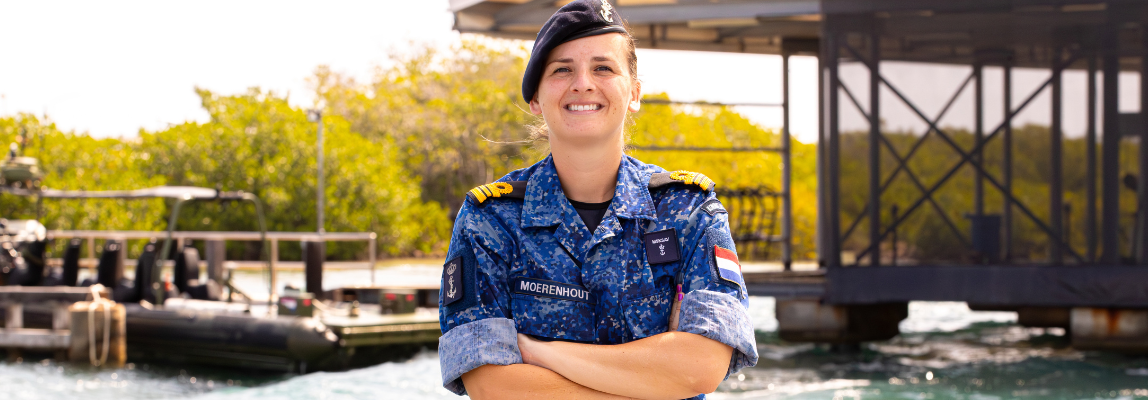
I had a much broader perspective all of a sudden
05/20/2026 - 15:16

- Stories
Interview: Maaike Dukker-‘t Hart
When I speak to Kady online, we have just come through a few bleak days of carnival. Don’t you miss that, I mean, your roots are in Brabant, right?
“I was called by my friends a couple of times during carnival, despite the time difference, and then I do miss it, yes. But I will be back in the summer of 2027, and then I’ll definitely be celebrating carnival in style again! I did take part in three parades here in Aruba this year – you just join a carnival group with some friends, all wearing the same headdress, which is great fun, too!”
You now work as Head of Logistics for the Ministry of Defence at the Savaneta marine barracks on the southwest coast of Aruba, but your journey started in Breda. You started the Facility Management programme in 2005, in one of the first cohorts, so you were a pioneer?
“You could see it that way. I actually wanted to go to the Hotelschool Maastricht, but they thought I was too young. I was 16. I was allowed to start a year later, but did not want to wait for that, so I visited an open day at NHTV. And there I found out about Facility Management, and had a much broader perspective all of a sudden.”
Has your wanderlust started at NHTV?
“No, not really. Although the international aspect was stressed there, and I saw countless opportunities, too, I just did my work placements in the Netherlands. That had everything to do with hockey, which I still found important at that age and I did not want to give it up. I would make different choices now, but at the time, I opted for a work placement at the Arjan van Dijk Groep and I sought my graduation internship close to home. I set up a small company that arranged facility services for student training companies of NHTV. I was then based at the Archimedesstraat location, and I was eager to come into contact with students from other study programmes, although it was mostly the students of Vrijetijdsmanagement who started their own company.”
Had you not wanted to do that after your studies, starting your own company?
“I gave it some serious thought. I do have an entrepreneurial streak – my parents, and my brother and sister too, run their own businesses – but I still preferred to continue studying. I felt as though I had not got the most out of it yet; I wanted to challenge myself more intellectually. At university, I suddenly had to pull out all the stops, but I had the discipline for it.”
It was at Radboud University in Nijmegen, the Political Science bachelor’s programme.
“When I started there I was 20, just like the other students, so I did not stand out. It was the first time I had lived away from home. After three years, I transferred to a master’s programme in International Relations at UvA in Amsterdam.”
If I calculate correctly, you were 24 when you graduated? And the move to Defence ... how come?
“At NHTV, I had a friend who was doing a work placement at KMA Breda, so I was already familiar with it. But it was actually because of my studies in Nijmegen. I did a work placement with the PVV (Party for Freedom), which they found quite interesting in Nijmegen – I mean, it is quite a left-wing university and a left-wing city. During that work placement, I worked for Marcial Hernandez; he was a Member of the House of Representatives for the PVV, but later left the party. Anyway, he was responsible for defence, and my main role for him was to work on defence policy. I undertook several working visits during that time, which helped me get a good sense of what the next step might be; I was particularly eager to gain practical experience. Initially, I wanted to do a traineeship at the Ministry of Defence, but due to budget cuts, that was not possible. Then I decided to apply to the Netherlands Defence Academy.”
You were still up for it after eight years of study?
“If you have already studied in civil society, you can attend a condensed track – that is what I did.
I deliberately chose the navy; given my background in political science, I reasoned that, as a trading nation, the Netherlands would benefit most from the navy – I mean, a land war did not seem likely at the time.”
And your background in facility management, how does that fit in with the story?
“To be honest, during my first ten years in the navy, my knowledge of facility management proved more useful to me than my political knowledge. I started out in operational catering, visiting mission areas to monitor food supplies and contracts. I then had leading positions on board as a logistics officer – responsible for teams in the areas of supply, catering, administration, and medical services. We were deployed, among other things, during the Ebola virus epidemic in West Africa (2014), hurricane Irma on Sint Maarten (2017) and the earthquake in Haiti (2021). Now, as head of logistics at the Savaneta Marine Barracks, I lead a team of around 50 people. So there’s also a significant element of Human Resource Management involved; something I learnt particularly well in Breda.”
So the Facility Management programme was a good foundation?
“I have to say, we spent a great deal of time focusing on competencies – so much so that at one point I had pretty much had enough of it. At university, it’s mainly about knowledge, but in the navy I discovered that those competencies are actually very important. For example, I learnt about leadership, among other things, through the practical training company of the Facility Management programme, and that has been so valuable!”
You have worked for Defence for around 12.5 years. You have just said you will come back to the Netherlands in the summer of 2027. And then?
“I am hoping for a position in The Hague, where my Political Science degree will come in handy again. In the navy, I have mainly been involved in the core business and therefore in operational matters. Now it is time to go into greater depth in the area of strategy and get more involved in policy, which is also in keeping with my rank (Lieutenant Commander Logistics at the Royal Netherlands Navy, ed.). As a member of the armed forces, you start in a new position every three to four years anyway.”
And now you are in Aruba for four years?
“We are already past the halfway stage – time is flying! My husband works here for the navy too. My elder daughter was nine months old when we moved here, and my youngest was born here. It is going to take a lot of getting used to when we go back to the Netherlands.”
What are you currently engaged in?
“Right now? Last week, a student doing his placement started with us – who is also a student of Facility Management – and I am giving him induction training. It is still taking some getting used to for him, the jargon and all that. In all the years we have been here at the barracks, we have never had a civilian student on placement, so it is a bit of getting used to for us too. My experience with work placements is that you are usually given very specific tasks. Here, we want to involve these students in everything – not just front office work, but also policy-making, so across all levels of the organisation. Security is a concern, so students doing their placement are always thoroughly vetted. It is an investment, but it fits very well with our policy of enthusing people about Defence.”
Defence is desperate for staff anyway
“The Ministry of Defence has indeed launched an initiative to recruit civilians. New tracks include Defensity College and what is termed a ‘service year’. The service year is a gap year and also a sort of taster placement after your studies to find out whether a career in Defence is right for you. You can do this straight after secondary school or after completing your studies. You can indicate which area you would like to work in and then gain experience, both at sea and on shore. It could also be something for people looking to change career direction, so if there are any readers of the Alumni Newsletter who are fed up with their current job, …”
Then I will send them to you! Who does not want to go to Aruba 😉
“It is really lovely here. We live outdoors here; everything is nearby, and we are very close to the beach. There is no need to plan a thing – dinner with friends, everything can happen spontaneously; wonderful. Still, I do miss the seasons; always sunny and 28 degrees is nice, but curling up on the couch with a blanket every now and then is lovely too!”